Saturday, 28 August 2010

Telling you this hyperbole free, this is the worst band I ever did see

Yesterday I was privvy to a once in a blue moon event of such magnitude it deserves sharing with myself and about 3 other people. I am now the proud owner of a brand new 'worst band I've ever seen'. For nearly 7 years the mantle was held by Rotherham's finest In the Event of Neo Tokyo, a band so rubbish they actually made rotten vegetables, broken bits of rust and glass, and soiled incontinence pads seem like a michelin-star meal. For those who missed out on the spectacle, from memory the band consisted of 3 guys in ill fitting clothes (think spray-on jeans and child sized tweed jackets) actually hopping and skipping about the place while one twat ragged on a shit ibanez a bit, while another one hit a fisher price drumkit and the singer crawled around on the floor screaming and colouring in. Some of that might have been embellished, but the bit about the singer crawling around and colouring definately was not. Anyway, Neo Tokyo played some alldayer in Sheffield with some pretty straightforward punk and hardcore bands, which made their performance seem all the more ridiculous. Some arty types out there might consider thinking oh how brave of them, such heart to express themselves in the face of such bourgeois banality to which I say, NO NO NO. They weren't brave to be making such nonsense, they were more likely off their faces on the silver paint they'd sprayed on their winklepickers before hand and thought they were the most 'out there' thing since Ike landed a haymaker on Tina.

Before I focus upon the band to which I afford this most rare of accolades, I would like to allay any fears of ignorance or prejudice with a simple pre-amble: I like Animal Collective. To elaborate a little, I prefer Feels to Merriweather Post Pavilion, thought Fall Be Kind was excellent, and even went to see Panda Bear and sat through an hour and a half set of about 2 notes. If that's not enough I own some Peter Gabriel CDs. I am an open minded music dude.

With that said it's on to the award! Silver envelope please, ta.

It gives me great pleasure to bestow the crown of WORST FUCKING BAND I HAVE EVER SEEN to...

Crystal Castles!!!


It seemed like a good idea at the time. I'm at Leeds Festival (don't hate the player, hate the game) to watch some mega label name indie bands and some 'hot tipped acts', and find myself with an hour or so to burn before The Get Up Kids (get me). 'How about that NME tent I've been reading about', my id chips in. 'Sure, why not, I've heard NME definately have the pulse on what's good in the world of music' concurs my sycophantic ego. So off I trot, full of joyous apprehension, imaginations running wild with what blessings this tent of magic and wonder could hold. What's this? The crowd is packed out beyond the rather ample tent borders? While The Libertines are performing elsewhere? This could only be a wonderful, error-free augury! Loads of impressionable teenagers can't be wrong!

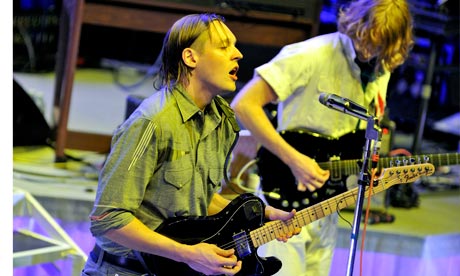
Then I walked in and saw through about 200 metres of total darkness some smelly bird on a stage fall off a drum kit while Scooter was playing in the background. Up she pops, takes a swig of Bombay Sapphire (what a classy alcoholic) and proceedes to squeel down a microphone like the kid at family do's that always makes too much racket while their parents stare at them like they're the most precious, precious thing. She then runs on the spot for a bit, screams for a bit more, and then falls over again. While Scooter plays in the background. And about 4,000 (probably an exagerration) people jump up and down like they're watching fucking Feeder or something. I look around me and everyone seems to be having a good time, which enrages me even more. Booing just doesn't cut it, so when the noise eventually stops I scream in anger, which some pre-teens in front of me mistake for appreciation and turn round and give me the thumbs up or something. Then they play another song that sounds like Scooter, and this bird climbs over everything and makes stupid noises. In hindsight it's like Basshunter if some posho smellies who are into shit American anime, collecting swords and sticking action figures all over their telly suddenly decided to take bear tranquilizers and make music that would really 'put it to the man'. Not since the days of Neo Tokyo have I been so utterly baffled, and so let down by my peers. Worse still, they weren't apologising for having an 'off day' or for the fact that they accidentally left the rest of the band at home, but said stuff through the microphone that I couldn't really hear but was probably telling people how fucking great they were. And the masses lapped it up like slightly sugary cream that brings luck and x-ray vision.

I would finally like to take this opportunity to say: Pitchfork, you are wrong. Vice, you are wrong. NME, you are wrong. Radio, you are wrong. Internet, you are wrong. That being said, if the internet is wrong, does that mean I'm wrong as well meaning that the internet is right, meaning that I'm still wrong? Or does it mean the internet is wrong but I'm somehow right because my thoughts pre-dating this existed before the statement about the internet being wrong so this remains pre-internet so even though the internet is eventually right it's still wrong?

On the plus side, it was good to see Rik from the young ones and the drug dealer from Pulp Fiction back in the public consciousness with their Arcade Fire collaboration.
Monday, 23 August 2010

All dogs go to heaven

It's silent tonight, there's the usual creaks and groans running through my house, and outside noises, but that's not what I mean. It's the first time I've been home for more than half an hour since yesterday morning. If it wasn't for work tomorrow I'd have stayed away longer. The house is just full of your smells, of your well-loved toys and stray hairs. Your food bowl's still out waiting for a meal that's never going to come, your lead hanging from the front door waiting for a walk that's never going to happen. The hardest thing to come to terms with is that everything to do with your existence is over. The inaction that comes with death hangs over everything like a punishment that's never going to go away. I'm not going to wake up tomorrow and have you back, or next week, or next year.

I remember the first time I held you was on the drive home from the farm that sold you. You were terrified, ears down, uncertain of us, of your environment, taken away from everything you knew. Once we got you home you tentatively explored our garden, beginning to see that maybe things weren't so bad. I remember kneeling beside you, lowering my head to your eye level, and waiting to see how you'd respond. I remember how you bounded up towards me like at that moment I was your best friend in the world, and nothing from that point could ever separate us. We were apart at times, through going to university and living in rented accomodation, but in all that time I'd come back to you and nothing ever changed. Even though I know life is fleeting, even though I've seen people come and go, see people die all around me, and even though I knew your time would come, I couldn't bring myself to envision it.

Yesterday morning was one of the worst few hours of my adult life. Never have I felt so hopeless and afraid, so utterly devoid of choice or power. As you died in my arms on that linoleum floor, I saw the same terror in your eyes that I saw that first day, the uncertainty, the bond changing from friendship to stranger through the curse of pain. But in your last moments, while I held your head, as the vet tried in vein to save you, you somehow managed to muster enough strength from your weak and bloodless body to raise your head and look me in the eyes with pure love.

You were my best mate, and I cannot conceive of the future weeks and months without you, coming into an empty house without your relieved circling and crashing tail, without our walking rituals, without you by my side wherever I happened to be. There is a hole where you used to be and I just don't know how to fill it.

I wish I could write something to give you weight and substance, but I feel the more I type, the more I cheapen what you meant to me. It was such a deep and personal thing that mere words can't encapsulate.

And yet loss is loss, a unique experience that is fundamentally shared by everyone.

For Amber, and every other friend, loved and lost.

Sunday, 15 August 2010

Alan


'For sale: baby shoes. Never worn.'
Hemingway

I received a box full of photos of my dad yesterday, along with various running medals and the rucksack he was going to use on a mountain climb that never happened. I opened and looked through them all today like some form of existential birthday present: to look at the man that was to see the man I will become, or some Star Wars bullshit like that. Like almost every other experience to do with my father, I examined everything with cold detachment, feeling as much loss for a man who is no longer here as I did for a father who was never there. To me, the binding quality of the photographs is the absence of his children. Of me and my two brothers. One photo of Tom, two of Julian, none of myself. Such absence is not a matter of blame, I don't think he was a bad father anymore than I think we were good children. Circumstances merely kept us at odds for the most part. In spite of this I can see in the collection of pictures - dinner parties, trips abroad, his work in the Middle East as a young man - aspects of myself, from mannerisms to dress sense. Even the now-faded life behind his eyes. I barely knew him as more than a name spoken with spite and sadness, but I somehow feel a meaningful connection nonetheless, beyond mere family name.

Saturday, 7 August 2010

Bookclub V - Imperial Bedrooms


They knew, of course, that it would have been very comforting indeed to believe that Eichmann was a monster, even though if he had been Israel's case against him would have collapsed or, at the very least, lost all interest. Surely, one can hardly call upon the whole world and gather correspondents from the four corners of the earth in order to display Bluebeard in the dock. The trouble with Eichmann was precisely that so many were like him, and that the many were neither perverted nor sadistic, that they were, and still are, terribly and terrifyingly normal... this new type of criminal, who is in fact hostis generis humani, commits his crimes under circumstances that make it well-nigh impossible for him to know or to feel that he is doing wrong.
Eichmann and the Holocaust - Hannah Arendt

The above quote is taken from Arendt's study of the Eichmann trial at Nuremberg. The book focuses on Eichmann's denial of wrongdoing, or of committing any evil, because he was simply following orders. This man allegedly held no ill-feeling to the German Jews whatsoever, yet was likely more responsible than any other individual for the final solution. Eichmann was the architect and facilitator of the largest-scale killing of human beings in history, yet acted only through self-interest, not malice. Arendt called this 'the banality of evil'. Monsters do not commit evil acts - humans do.

It is with these ideas of evil in mind that I turn to the latest Doghead tome - Imperial Bedrooms, the new book by Brett Easton Ellis. Imperial Bedrooms is less a morality tale, and more an amorality tale. 25 years after Less Than Zero, Ellis returns to Clay and the other lost children of his first novel, now faced with mid-life crises as opposed to adolescent troubles. In this short novel, Clay gets embroiled in a mess of kidnappings, torture and murder.

In a break from Less Than Zero, Clay is the book's Patrick Bateman, becoming the practitioner of evil acts rather than merely an observer. In a way, Clay is even worse than Batemen, certainly more dislikable. Floating through the book in a narcissistic, drunken haze, he don's Hamlet's cap and lets unbearable acts of violence happen to those closest to him through mere selfishness and self-pity. To me, the most striking attribute of Imperial Bedrooms is Clay's intrusion to the plot. Ellis writes as if Clay has stumbled upon a story that was never meant to be his. Characters constantly refuse to explain details to him, or to allow him to get involved. Through sheer will and debasement of all those close to him, he eventually makes himself central to the story to everyone elses detriment.

In a similar vein to Ellis' other work, the large portion of the story is mundanely simple sentencing, peppered with occasional outbursts of emotion or extreme violence. Most of the violence, even, is spoken of in matter-of-fact terms, devoid of emotion. Some misundersand Ellis and see his books as irritating and boring, but the language itself contributes to the story. The scene below could have been told a hundred different ways, but by Ellis using the sort of simple language he does it homes in on the dull, banal nature of Clay's evil.

I lean in to kiss her face.
She turns away. 'I don't want to,' she mutters
'Then get out of here,' I say. 'I don't care if you ever come back here.'
'Amanda's missing and you're-'
'I said I don't care.' I take her hand. I start pulling her toward the bedroom. 'Come on.'
'Just let it go, Clay.' Her eyes are closed and she's grimacing.
'If you're not going to do this, then you should leave.'
'And if I leave, what will happen?'
'I'll make a call to Mark. I'll make another call to Jon. I'll call Jason.' I pause. 'And I'll cancel everything.
She immediately moves into me and says she's sorry and then she's guiding me toward the bedroom and this is the way I always wanted the scene to play out and then it does and it has to because it doesn't really work for me unless it happens like this.

Despite the majority of the language being empty and throwaway, Ellis can write as beautifully as those he's been compared to - Hemingway, Carver, Bellow and Yates - when circumstance demands it. This excerpt immediately follows a truly extreme act of sexual violence, and also the moment Clay stops being the observer and truly involves himself in the sadism of the modern world.

The sky looked scoured, remarkable, a cylinder of light formed at the base of the mountains, rising upward. At the end of the weekend the girl admitted to me that she had become a believer as we sat in the shade of the towering hills - "the crossing place" is what the girl called them, and when I asked her what she meant she said, "This is where the devil lives," and she was pointing at the mountains with a trembling hand but she was smiling now as the boy kept diving into the pool and the welts glistened on his tan back from where I had beaten him. The devil was calling out to her but it didn't scare the girl anymore because she wanted to talk to him now, and in the house was a copy of the book that had been written about us over twenty years ago and its neon cover glared from where it rested on the glass coffee table until it was found floating in the pool in the house in the movie colony beneath the towering mountains, water bloated, the sound of crickets everywhere, and then camera tracks across the desert until we start fading out the yellowing sky.

Less than Zero was hailed as tapping into the lost generation of the rich LA youth, and became an 80's classic as a result. It seems with Imperial Bedrooms Ellis in response wants to smash any hope of redemption for the characters. They are beyond redemption, a product of absent parents and hedonistic upbringing. The real-life stars of the real-life adaptation of Less than Zero are rumoured to all be returning for the Imperial Bedrooms adaptation. It remains to be seen in what ways the worlds of literature, film and reality can further overlap and co-exist.

Monday, 2 August 2010

Bookclub IV - The Death of Bunny Munro


'...and she said her name was Penny Charade... I kid you not. Penny Charade... I'll never forget it... and when I told her my name she laughed and I laughed and I knew that I had this power... this special thing that all the other bastards who were flopping around in the pool trying to impress the girls didn't have... I had this gift... a talent... and it was in that moment that I knew what I was put on this stupid planet to do...'

Bunny gropes around on the bed until he finds the remote and, with a crack of static, it implodes into nothingness and he closes his eyes. A great wall of darkness moves towards him. He can see it coming, vast and imperious. It is unconsciousness and it is sleep. It moves like a great tidal wave but before it breaks over him and he is away, before he renders himself completely to that oblivious sleep, he thinks, with a sudden, terrible, bottomless dread, of Avril Lavigne's vagina.

It is needless to say that I am a Nick Cave fan, but I've said it anyway. This blog's name (as well a my zine and ill-fated label) is taken directly from a Nick Cave book: And the Ass Saw the Angel, but you all knew that already.

Anyway, sycophantic praise aside, by sheer chance I spotted The Death of Bunny Munro on a shop bookshelf on its week of release, and quite likely made some sort of yelping sound before throwing money at someone and reading it on the closest toilet to hand. Bunny, essentially, revolves around one man's descent into increasingly depraved encounters with members of the fairer sex. Bunny is a cosmetic salesman, and master cocksmith, but following his wife's suicide he finds both tasks a lot more of an uphill struggle, especially with his young son in tow. An ill-fated journey ensues as Bunny attempts to finish his client list, while a serial killer dressed as the devil slowly makes his way south...

The scope and Scale of Bunny Munro is so, so different from And the Ass... it took some acclimatising. The book's entirely set in the very real place of Brighton, Cave's place of residence for some years, which is a far cry from the hugely abstracted apocalyptic americana/australiana of And the Ass... The lyrical voice of Bunny is clearly different too, Bunny Sr sounding so much older, the world around him miserable just by its dull reality. Like everything Cave does the book is poetic and flows brilliantly, the pages bleed menace, and I often found myself castigating myself for rooting for such a horrible degenerate. Having said that, I think a bit of Bunny resides in every man, he certainly has aspects of Cave in him - just listen to Grinderman. I have to say I was left a little cold by the resolution, but then And the Ass... is one of my all time favourite books, so it was always going to be a hard book to equal.

A few months after, I noticed that an audiobook version was being released, and purchased that with almost as much relish. I actually found that I enjoyed the audio version of the book a hell of a lot more. The voice of Bunny sounded so much more genuine when put through the Aussie twang of Nick Cave. As an added bonus, the whole story has a sparse Warren Ellis/Nick Cave soundtrack, which is surely a must-have for the Nick Cave completionistas. The whole book has this unmistakeable 'road trip in hell' quality about it and for that reason it begs to be heard on a dark drive down the M1. Just look out for those cement mixers.

In honour of the audio greatness, here's a youtube link to Cave reading one of my favourite parts.

Monday, 26 July 2010

Lost Dogs - prologue


(At the rate I'm going I'll have a book's worth of unfinished crap by the end of this year.)

When he saw the flames outside, heard the screams that seemed to be so close and yet so far away at the same time, he opened his front door in case the dogs wanted to leave. He wasn't entirely sure of his decision, but felt it was fair to give them fair opportunity to leave should they so desire. They pattered up to the front, ears pricked, and let out a snort or two, the beginning of a bark then seemed to think better of it and looked up at him, ears now pinned back. He thought at first that they might have been happier in the wild, but it now seemed obvious that they were as comfortable in these four walls as him. He ruffled the fur behind their ears and closed the door, walking through the silent house, his home for what seemed at this moment like forever. Every wall, cornice, picture rail and skirting as familiar to him as his own hairs, warts and wrinkles. He ran his fingers along a wooden panel, feeling the peaks where paint drops had dried decades before, then ran them into crevices where pram handles had scuffed or bicycles had chipped, now many years since. The house was dim, lit only by the glow of the growing fires outside but even in pitch darkness he could navigate his hallway and rooms with ease. The furniture never changed position - except when he felt the need to clean. He made his way to the kitchen and the dogs bobbed behind him devotedly. He reached into the dog's sack and felt for the scoop, whereby he filled both their bowls with enough dry food for a week or so, just in case something happened and he didn't get another chance. The dogs sniffed the heap of kibble on the floor, hesistated, and crunched a few pieces between then before catching up to their master at the back door. He stood looking out into his garden, the darkness of the great unknown rendered uncertain by the fire scattered across the land. He stopped his observations momentarily to ascertain whether his running commentary was natural or whether a mere calming mechanism, like repeating a song over and over in one's head in troublesome times. He felt awfully rational and composed considering the state of things outside his front door, but on reflection he didn't suppose there was a particular way of behaving when the world was ending.

Sunday, 11 July 2010

Bookclub III - The Good Man Jesus and the Scoundrel Christ


What you have here is a book which by all rights should be an instant classic. An eloquent and passionate critique of organised religion wrote in the form of a gospel, Philip Pullman has managed to write a book that is a damning critique of the Christian church, while simultaneously writing with much love and reverence of the source material. If the Hitchens and the Dawkins of the world feel a little overly antagonistic to your, Pullman's Good Man Jesus and Scoundrel Christ may be more up your alley.

There is a rather large clue to The Good Man Jesus... on the back cover, which in huge letters reads THIS IS A STORY, Pullman, despite writing a book in the style of one of the four gospels, makes it quite plain from the start that it is not a heretical dig, but a work of fiction. I read the book in two afternoons - while appearing quite sizeable, the layout of the text is more akin to poetry than prose, and the font size is rather large. Normally I would be unhappy about shelling 15 quid for such a short novel, but the final product is very well made, from two font colours, to the ribbon bookmark. In retelling the story of Christ, Pullman takes the man Jesus Christ and makes him into twin brothers. Jesus: a rebellious figure who sees great injustice in the world and sees a chance to bring justice to the meek, and Christ: a quiet, contemplative figure who wants to save the whole of humanity through very different means. A shadowy figure follows Christ, instructing him to document the actions of Jesus, to tell his story in a way that would give the people truth to life, existence, and God. Ironically, Christ retells Jesus' tale in a way that is not entirely truthful, in essence adding legend and miracle to the actions of a good natured, but very normal man. This book begins as the story of Jesus Christ, but ends as an insight into the creation of the Christian church.

In interviews, Pullman has talked about his Christian upbringing, and of his open admiration for the stories within the bible. The Good Man Jesus and Scoundrel Christ is not only an indictment of organised religion, but is to all intents and purposes another authentic attempt at the retelling of the Bible story. It is worth noting that 12 gospels exist, some would say more, taking into account the recently found Gospel According to Judas Iscariot. It's quite clear why some of these gospels were ommitted, such as The Gospel According to Thomas, which talks of an infant Jesus transforming his schoolmates into goats and other such nonsense. The gospels themselves were originally compiled in the 2nd century, and were authored by anonymous writers, only given titles in hindsight. To what extent are these gospels truthful? Were the miracles performed as described, or was poetic retelling of historical moments later taken for physical fact? The Good Man Jesus and Scoundrel Christ doesn't necessarily have the answers you're looking for, but then maybe the New Testament doesn't have the answers either.

Here is an excerpt from close to the end of the book, where Jesus converses with God in the garden at Gethsemane, shortly before being arrested by the Romans. The conversation develops page after page, and is really quite a passionate monologue/conversation, which I think most agnostics and atheists (perhaps even religious) will find common ground.


'Have I been deluding myself as well as everyone else? What have I been doing, telling them that its going to come, that there are people alive now who will see the coming of God's Kingdom? I can see us waiting, and waiting, and waiting... Was my brother right when he talked of this great organisation, this church of his that was going to serve as the vehicle for the Kingdom on earth? No, he was wrong, he was wrong. My whole heart and mind and body revolted against that. They still do.

'Because I can see just what would happen if that kind of thing came about. The devil would rub his hands with glee. As soon as men who believe they're doing God's will get hold of power, whether it's in a household or a village or in Jerusalem or in Rome itself, the devil enters into them. It isn't long before they start drawing up lists of punishments for all kinds of innocent activities, sentencing people to be flogged or stoned in the name of God for wearing this or eating that or believing the other. And the priviledged ones will build great palaces and temples to strut around in, and levy taxes on the poor to pay for their luxuries; and they'll start keeping the very scriptures secret, saying there are some truths too holy to be revealed to the ordinary people, so that only the priests' interpretation will be allowed, and they'll torture and kill anyone who wants to make the word of God clear and plain to all; and with every day that passes they'll become more and more fearful, because the more power they have the less they'll trust anyone, so they'll have spies and betrayals and denunciations and secret tribunals, and put the poor harmless heretics they flush out to horrible public deaths, to terrify the rest into obedience... (This goes on for quite a while)

'Lord, if I thought you were listening, I'd pray for this above all: that any church set up in your name should remain poor, and powerlessw, and modest. That it should wield no authority except that of love. That it should never cast anyone out. That it should own no property and make no laws. That it should not condemn, but only forgive. That it should be not like a palace with marble walls and polished floors, and guards standing at the door, but like a tree with its roots deep in the soil, that shelters every kind of bird and beast and gives blossom in the spring and shade in the hot sun and fruit in the season, and in time gives up its good sound wood for the carpenter; but that sheds many thousands of seeds so that new trees can grow in its place.'