Saturday, 30 April 2011

XVIII - The Final Testament of the Holy Bible


I am loathe to be 'on the pulse' of anything, but flicking through some disposable literature the other day while waiting for my personal shopper to fetch me my Prada slippers I noticed that Vice magazine seems to have published an article/interview with the author of The Final Testament James Frey. Bearing in mind his latest book has only 10,000 existing copies, and mine is signed (I should mention it is pre-signed, I never met the guy) then this blog post could be a yellow brick road that leads all the way to yours truly getting some kind of wizardy sum on ebay for this in a few months time.

That being said, it will probably go for less than I paid for it. James Frey seems to have that kind of effect on people. His first book A Million Little Pieces (or something like that, I haven't read it) was widely hailed as a deep and touching memoir of drug addiction and other such troubles, then in almost as quick a period was widely loathed and reviled for being 'mostly' made up. Oprah Winfrey even had Frey go on her programme to apologise to the people of America. Then last year he got poo pooed by everyone for wanting to set up a fiction venture where he paid post grads to write commercially appealing books for him (even though the likes of James Patterson have done this for YEARS). His latest book, The Final Testament of the Holy Bible however is all his, and seemingly looked set to cause an international stir fry (thus far a rather quiet storm - perhaps clergymen are having difficulty in picking up a copy?)

Anyway, enough snidish witticisms from me, as this book is actually rather enjoyable, certainly much more so than I expected it to be. The book follows the life of a young New Yorker by the name of Ben Zion who miraculously survives a horrific accident and goes on to be seen as the Messiah by a variety of resident New Yorkers (Judith can suck it though).

It begins:
He wasn't nothing special. Just a white boy. An ordinary white boy. Brown hair, brown eyes, medium height and medium weight. Just like ten or twenty or thirty million other white boys in America. Nothing special at all.

First time I saw him he was coming down the hallway. There was an apartment across the hall from where I lived that'd been empty for a year. Usually apartments in our project go quick. Government supports them so they're cheap, for people who aint got shit in this world, even though they always telling us different, know we ain't ever gonna have shit. There's lists for them. Long and getting longer. But nobody would live in that one. It had a reputation. The man who lived there before had gone crazy. He'd been normal. Sold souvenirs outside Yankee Stadium and had a wife and two little boys, real cute little boys. Then he started hearing voices and shit, started ranting about devils and demons and how he was the last man standing before us and at the end. He lost his job and starting wearing all white and trying to touch everybody on their head. He got his ass whooped a few times and his church told him to stop coming. He screamed at his family and played organ music all night. Cursed the demons and pleaded to the Lord. Howled like some kind of dog. He didn't ever let his family leave. We stopped hearing the music and it started smelling and Momma called the cops and they found him hanging from the shower. Wearing a white robe like a monk. Tied up with an electrical cord. They found his wife and boys with electrical tape around their ankles and wrists and plastic bags over their heads. There was a note that said we have gone to a better place. Maybe the Devil got him or the demons got him or the Lord left him. Or maybe he just got tired. And maybe they did go to a better place. I don't know, and won't probably ever know, not believing what I believe. And it didn't matter anyway. Everybody heard about it and nobody would live there. Until Ben. He came down the hall with a backpack and an old suitcase and he moved right in. He either didn't know or didn't care about what had happened before. Moved right the fuck in.

Annoying, Palanhuick-esque punctuation aside, the book really did draw me in from the start, establishing very quickly an entirely human charicature of a modern day messiah living in New York city, told through the accounts of his 'disciples'. Ben Zion is certainly an iconoclaust of the Holy Son, drinking, puking, hanging out with gun toting tramps in the New York city subways, bisexual, fornicating with pretty much anything that moves, and pretty darn critical of organised religion. People turn to him for Godly advice and time and again he replies with a simple ajunct: 'there is nothing after your time here, heaven and hell exist here on earth, so love each other'. Simple as that, and to be honest it's a philosophy that you really don't need this book to adopt. In fact, the few chapters where Frey further explores the 'love-in manifesto' are pretty much the only turgid and tiresome pages in the whole thing. In fact, skip the Judith chapter entirely because I found it a little too much, and either side of that you've got a well-paced, involving and ultimately heart breaking story. In much the same way that people see the life of Jesus as a thrilling human story and nothing more, you can see The Final Testament in much the same way.

I'm not sure Frey is going to attract much ire in response to The Final Testament, at least not in Europe and the UK. He is after all treading the same ground that Dawkins, Harris, Hitchens et al have been pursuing tediously for what seems like years now. Controversy aside, it's a pretty unique retelling of the Bible story, and sits well in contemporary society inasmuch as he's pitched it as plausibly as a retelling of the Christ story can be. The ending is definately a gut-punch, and in its way far more cruel and contemporary a punishment than crucifixion. I suppose an easy parrallel to draw would be with The Good Man Jesus and Scoundrel Christ (see Bookclub III), I would say in balance that Pullman's version is more eloquent but Frey's perhaps more involving and empathic. The Final Testament strips away the dogma and rigid certainties of the New Testament, and replaces them with ambiguity and questions. The ambiguity of The Final Testament is refeshing. Ben never admits to being the son of God, his revelations always come in the aftermath of severe epileptic seizures, his 'miracles' could be hustles just as easily, and rather than bringing Lazarus back to life he commits an act of euthanasia instead. It's this perhaps that's the most radical aspect of the book inasmuch as it goes against so many religious teachings, yet at the same time suggests such a simple alternative in order to lead a 'good life'. Don't be a dick, basically.

You look up there...
He motioned towards the altar, towards the crucifix hanging above it.
And you look at that piece of dead wood, beautifully carved, and beautifully painted, but still a piece of dead wood, and you think it represents someone, and you think that someone is me.
Yes.
I'm not him.
You are.
I am not.
Is this a test?
No.
I know that God tests our faith every day, that being tested is part of faith.
God does no such thing.
And I believe this is exactly the type of test I would expect from him.
He laughed at me.
And I want to pass the test. I want to prove myself worthy of whatever God has in store for me.
God doesn't know you exist, and doesn't care about you.
I don't believe you.
So be it, but it's true.
How do you know?
Because God speaks to me.
Literally speaks to you?
Not with some silly voice, as it happens in the Bible.
Then how?
How doesn't matter. What does.
And what is that?
That this is all a fraud. This church, every church. That the world's religions are bankrupt and meaningless. That the world itself is bankrupt. That it's all going to end.
As has been foretold.
I know every word of every holy book every written. None of them foretell what is coming.
Revelations does.
Revelations is a stone age science fiction story.
If that's so, who are you?
Who do you think I am?
Despite what you say, I believe you are Christ reborn.
I'm a final chance.
You're here to redeem and forgive us.
There will be no redemption, and no forgiveness.
You're here to resurrect the dead, redeem the living.
I'm here to ward humanity that it is going to destroy itself in the name of greed and religion. That there is no God to save any of us. There is no Devil to take us to Hell. That man's only enemy is himself, and only chance is himself.

Saturday, 16 April 2011

XVII - Meat is for Pussies


I feel to a certain extent that even in moving to London I have kept my personal integrity intact. It's only been two weeks, but so far I have gone to bed before 10 most nights, and both weekends have managed to stay indoors while outside the city roars. This suits me quite fine, I have no intention of becoming a shoreditch hipster or a bicycle courier just yet, biscuits and beer, a good book, and a healthy slap of spotify is all a man of my meagre stature needs to enjoy life.

While we're on the subject of personal integrity, it is probably worth mentioning that certain moralistic principles are not as intact as they used to be. Talk to me 3-4 years ago and I would have still been a happy go lucky vegan straightedge warrior, eager to fight the fight for the cat the cow and the rat (fuck the foetus), but these days I'm guzzling milk and beer (never at the same time) and hunkering down on eggs and cheese like there's no tomorrow. There's even been a few morally reprehensible occasions where I've chowed down on reindeer, fish and a steak or two (and a few bags of haribo, but what's gelatin between friends). It's time like this, when I'm soaking in the ethical mire of the turncoat, that I need a book to engage and enrage me once again, remind me what I came into this world for. It's just a shame that I expected John Joseph's book Meat is for Pussies to be the Ishmael for the 21st Century.

John Joseph, as the 3 people who read this blog already fucking know, is most famous for fronting the best hardcore band of all time, Cro-Mags, and less famous for Both Worlds (better nu metal record than Suffer Survive, pricks). He also wrote an excellent memoir of life in 1970's New York, Evolution of a Cro-Magnon which was hugely gripping and entertaining. I really was looking forward to his next effort. Straight off the bat, I'm not a fan of this book, and I feel terrible for saying so. But it's just not that good. Most of the time the book either feels like a one-sided rant or some kind of street corner hustle. Meat is for Pussies is JJ's attempt at bringing a dose of masculinity and testosterone to the pro-veggie argument. Photos of musclebound vegans abound as well as short, snappy, aggressive monologues presents the book as a sort of get straight programme for the morally inept. A large portion of the book's focus is on health and wellbeing - diet, energy levels, exercise, etc. And that's all well and good, but the book reads more like a pushy conversation in a bar between friends than a reading experience. It reads like a hashly put together zine most of the time, I read the thing literally in two hours and the book's nearly 300 pages long. The font size is large and there's a lot of white space on every page, so it's a lot shorter than it looks. Here's a brief example of what you're letting yourself in for. Think of these paragraphs, but for 150 odd pages.

Now you may say, "Man, it's too much of an inconvenience to do all that." Well, talk to my friend who has to go on kidney dialysis three days a week for five hours each day because prescription medication and a bad diet ravaged his kidneys. Or visit a cancer ward where people are having their colons or cancerous polyps ripped out of their assholes. Or go to a drug store and watch the faces of the people coming to pick up their $300 worth of medicine every week...

I'm gonna tell you something you probably already know deep down inside: you're eating like a lazy pussy. That has to change, and it will. Want to know why? You've already taken the first step by reading this book. The first step in drug rehab is admitting you're an addict. And even though I'm busting your chops like those guys at Rahway State Prison, I care about you the same way they cared about me.

I guess the best way for me to describe the thing is like an entry level book on vegetarianism. If you're a meathead from Dudley and have 'MOSH' tattooed on your shins you will probably find this book illuminating. If you are aware that Paul McCartney is a vegetarian or have heard of PETA, this book will probably not tell you anything you don't already know. And most of what it does tell you is questionable nutritional 'science'and the odd conspiracy theory. The most I got from this book is a few laughs, especially hearing some of JJ's insults in a thick New York accent with my mind's ear, and there's some cool recipes at the end of the book too. So if you see it as a cookbook with a 200 page preface you will probably get quite a lot from it.

Saturday, 9 April 2011

XVI - First as Tragedy, Then as Farce


One week in London and I've already polished off two books. Actually, that's a bit of an exaggeration, I'd almost finished one of them so it was more like one and a bit. Anyway this post concerns that very book, First as Tragedy, Then as Farce by Slavoj Zizek. The man in my opinion is a genius, a Foucault of the 21st century, which he and probably the rest of the philosophical community would despise as a description, being comprised of little more than hyperbole and miniscule comparative relevance. All the same, Zizek is a fucking genius, and I love how his brain works. Open any of his books and you're likely to find a mish mash of world affairs, economic and political philosophy, mixed in with allusions to pop culture and society. The man blends Blade Runner and Batman with political theory, and makes it work. In parts I find some of his ideas too dense for my straight thinking brain, but Zizek always seems to be conscious in his writing being enjoyable to read as often as possible, which for someone like me is utterly refreshing.

First as Tragedy deals largely with the economic collapse of 2008 and the world post 9/11. It comprises of a critique of modern capitalist democracies and its evolution into the sort of authoritarian capitalism we see in China today. I am loathe to write much about what the book comprises because the book is so full of ideas I risk either distorting or omitting the most salient aspects of the book's message. In actual fact, were I to truly reflect on my reading experience of First as Tragedy, or other such philosophical works, I would need to do so in a much more structured and thought out format than a blog post. A zine at the very least! (Please see Doghead issue one - available free in this very blog - for my first attempt at such analysis). Suffice to say that Zizek is heavily critical of the radical measures employed by the global community to bail out the banks, and wonders, among other things, why such a financial priority is given to the very institutions that brought about the collapse in the first place. Zizek then goes on to analyse the development of communism and communist thought, arguing that even the most pure attempts at communism were poisoned and distorted before they ever acheived their true intentions, and advocates an optimistic rethinking of communist values, to 'fail better' next time.

Here follows an extract from towards the end of the book, where Zizek quite optimistically answers the Leftist question of 'what next'. As he mentioned elsewhere in the First as Tragedy, it is all to easy to criticise and lambast the centre-right for what they're doing to the world, but what needs to accompany such critique is viable, workable alternatives.

There is only one correct answer to those Leftist intellectuals who desperately await the arrival of a new revolutionary agent capable of instigating the long-expected radical social transformation. It takes the form of the old Hopi saying, with a wonderful Hegelian twist from substance to subject: "We are the ones we have been waiting for." (This is a version of Gandhi's motto: "Be yourself the change you want to see in the world.") Waiting for someone else to do the job for us is a way of rationalizing our inactivity. But the trap to be avoided here is that of perverse self-instrumentalisation: "we are the ones we have been waiting for" does not mean we have to discover how it is we are the agent predestined by fate (historical necessity) to perform the task - it means quite the opposite, namely that there is no big Other to rely on. In contrast to classical Marxism where "history is on our side" (the proletariat fulfils the predestined task of universal emancipation), in the contemporary constellation, the big Other is against us: left to itself, the inner thrust of our historical development leads to catastrophe, to apocalypse; what alone can prevent such calamity is, then, pure voluntarism, in other words, our free decision to act against historical necessity.

Beautiful words which I think my brain is still trying to get to grips with. First as Tragedy is the sort of book that many will find compelled to return to time and again, re-reading its 170 odd pages to try and understand a little bit more each time. And I expect many more will disregard as leftist-tripe or dense nonsense. Their loss.

For those who hate reading, you can check Zizek and a number of other notable philosophers on a documentary called Examined Life. The below extract is Zizek talking about waste, and it's ridiculous/mind blowing.

Saturday, 2 April 2011

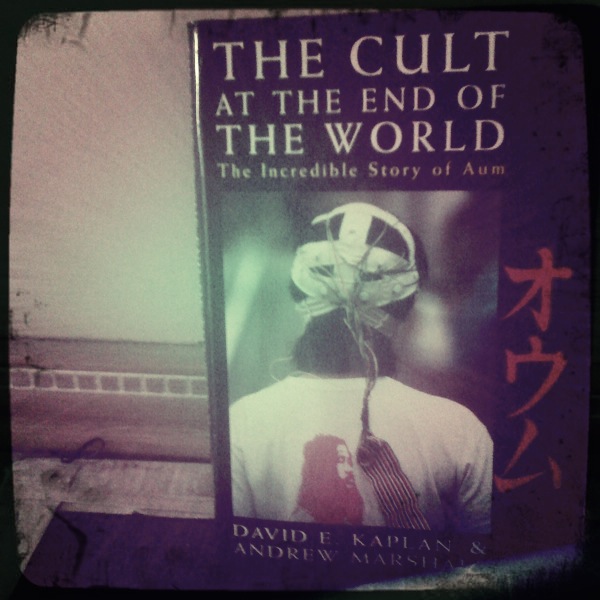
XV - The Cult at the End of the World


When I was younger I wasn't one of those kids that had free reign of watching the telly. I remember being about 6 and sneaking into my brother's room to watch Dead Calm and my mum going ape shit. Robocop was a film that by some miracle I managed to watch the entirety of at a young age and it still kind of disturbs me to this day. By and large though my mum had a good idea what I was up to and did her best to shield me from cinematic horrors, for all the good it did. One thing she was inevitably incapable of however was shielding me from the horrors of the real world and what one human being could do to another. I remember being about 10, and starting to see the world for what it was, the crises in Kosovo and Sarajevo, the chemical attacks on the Kurds, mass starvation and civil war in Ethiopia. Then out of the blue I saw new faces on the television. Not refugees: old ladies in headscarves wailing and bony, bloated children with flies on their face, but instead businessmen and commuters with blood seeping from every orofice, killed on their morning commute to work by an invisible killer. Nerve gas they called it. In no time at all the news was going on about this Japanese death cult that masterminded the attack and wanted nothing more that the apocalypse. Needless to say I was terrified.

Aum Supreme Truth was an international movement boasting hundreds of thousands of initiates with membership including Japanese government officials, Yakuza, and even Russian military officials. A 'blind' guru, Shoko Asahara was the head, and talked constantly of armageddon. The majority of his followers were highly intelligent scientists and engineers, most of them poached from university, jaded by Japanese adult life and seeking some sort of higher purpose. Asahara combined traditional Eastern religion such as Hinduism and Buddhism with apocalyptic Christian Revelations and Science Fiction, citing Shiva as some kind of earthy end-bringer. Aum's beginnings were more modest, but Asahara eventually managed to use the cult as a way of generating millions of Yen in revenue, but it seemed the more scrutiny was put upon the cult, the more Asahara quoted the end times, and apocalyptic war at the hands of Aum as some sort of spiteful retribution on a world-ending scale.

Good news for Holy Terror bands wanting to create an authentic lyrical experience; The Cult at the End of the World is clearly well researched by David Kaplan and Andrew Marshall, with a multitude of accounts from cult members, critics and victims alike. The book explores Asahara's life and the timeline of Aum from it's modest beginnings in a single Yoga class, to a worldwide terrorist organisation responsible for a number of murders spanning years, culminating in a sarin nerve gas attack on the Tokyo subway. The relatively short lifespan of Aum is rendered in great detail, and some of the motives for such terrible acts of mass killing are explored as the book progresses. Aum experimented with all sorts of drugs and brain surgery, they lobotomised and permanently disfigured scores of people, and murdered anyone that tried to speak out against them, almost with entire impunity, thanks largely to the inability of the Japanese authorities to pin anything on them (as well as the subterranean ovens Aum disposed of the bodies in). It is truly terrifying to imagine that Aum were in talks with current and ex Russian military personnel with the aim of acquiring long range missiles and even nuclear material. Aum purchased an attack helicopter but never succeeded in constructing it.

The Cult at the End of the World is certainly sensationalist in parts, part of the difficulty in keeping a reader's interest in current affairs books I suppose is to write in such a manner as to maintain interest. One such example is the quote below, which could quite easily chill the blood, especially considering 9/11, 7/7 etc. It is worth keeping in mind just how infrequent terrorist attacks are however, at least in comparison to car accidents, heart attacks, etc. If it's of any comfort, you certainly will die, but it's not that likely going to be from Chechnyan rebels launching mustard gas or the IRA putting the ebola virus in bottles of fanta.

It would be easy to dismiss Aum as a peculiarly Japanese case, and indeed, there are conditions in Japan that shaped the cult's unique character. The straitjacket schools and workplaces, the absentee fathers and alienated youth no doubt helped fuel Shoko Asahara's rise to power. But to suggest that what happened in Japan could not happen elsewhere would be a dangerous mistake. Ineffective and bungling police, fanatic sects, and disaffected scientists are hardly limited to the Japanese.
Aum's forays into conventianal weapons - its explosives and AK47s - were alarming enough, as were the cult's eerie experiments with electrodes, drugs and mind control. But where Asahara and his mad scientists charted new ground was in their pursuit of the weapons of mass destruction. This, unfortunately, will prove Aum Supreme Truth's lasting legacy: to be the first independent group, without state patronage or protection, to produce biochemical weapons on a large scale. Never before had a sub-national group gained access to so deadly an arsenal.
As the Cold War recedes into history, we leave behind a strange stability from the balance of terror that once existed. It was a time of mutually assured destruction, when communist and capitalist superpowers divided the world neatly into two well-controlled camps. Terrorism was by and large state-sponsored and politically motivated. Now, as the new millennium approaches, we face another kind of threat, one of unrestrained killers and renegade states armed with the deadliest substances on Earth.
The word is out. A college education, some basic lab equipment, recipes downloaded from the internet - for the first time, ordinary people can create extraordinary weapons. Technology and training have simply become too widespread, too decentralized to stop a coming era of do-it-yourself machines for mass murder. We are reaching a new stage in terror, in which the most fanatic and unstable among us can acquire the most powerful weapons.

Wednesday, 30 March 2011

We're taking back what they stole.


I've had my second bath in three days today, just to try and wash my cuts out. The dirt is hanging tough though, maybe it wants my fingers to look like seal, kissed from a rose. I look at the newly formed scars and can remember how some of them got there, others not so much. V-shaped scar on my little finger opened up from a beer bottle smashing across my hand. The zipper etchings across my inner index finger as if caused by some miniature wolverine. The bruises and cuts across each knee could have been caused by any number of things. I don't remember splitting my lip open, but it's there all the same, purple and warm to the touch. I'm sitting here now in my kitchen, a world away from the fortnight that was, listening to Gideon Coe playing all my heroes on the DAB. This time last week I would likely have been in some sort of metaphorical bin, head swimming with alcohol and music-induced rage, or happiness for that matter. If I rack my brains hard enough I could probably work out my exact place in the world back then, but that would be missing the point. Tour isn't about the precise details, it isn't about the specific faces or stages or t-shirts or anything like that. It's about the greater whole, the sense of freedom, the feeling of responsibility with a lower case 'R', a sense of a diminished world, living for the van, for the next bed, for the next beer, for the next 30 minute set and whatever chaos that brings. I'm not for the tiniest second believing that I've done anything new or revolutionary, every beer soaked venue plastered with a patchwork quilt of bands that never made it keep my feet firmly on this stale earth. I'm walking the footsteps of countless teenage dreamers and twenty something revolutionaries, who felt they had something to tell the world, through riffs or poetry or whatever. People who for however long stepped off the path chosen for them and tried to choose a direction for themselves - one clubhouse at a time. But just because it's nothing new doesn't mean it's nothing special. These last few weeks are full of memories and experiences that everyone, including myself, will take with them for the rest of our lives. We may end up sat behind a desk making money for people we never meet, or stuck in a domestic existence that saps every rebellious energy argument by argument. But one thing no-one can take from us is our experiences, they will always be ours, embarrassing, exhilarating, painful, or lost in a haze of beer and whiskey. For 10 days, we could be more like the human beings we always dreamed of being and maybe even find some fleeting moments of happiness.

Friday, 25 February 2011

XIV - J'irai Cracher sur vos Tombes


She opened her eyes and I sniggered. She didn't understand. So I told her the whole story, the whole story about the kid, at any rate, how he's fallen in love with a girl, and what her father and brother had done to him afterwards. I explained to her what I'd decided to do with Lou and her - get even, two for one. I fished in my pocket and found Lou's watch; I showed it to her, and said I was sorry not have brought her one of her sister's eyes, but that they were too messed up after the special treatment-my own invention- that I'd just finished giving her.

It was hard for me to say all that. The words didn't come easily. She was there, eyes closed, lying on the ground with her skirt turned up to her waist. I felt that thing again all down my back, and my hand closed over her throat all by itself; it came; it was so violent that I let go of her and almost stood up straight. Her face was already blue, but she didn't budge. She'd let herself be strangled without lifting a finger. She must've still been breathing. I took Lou's revolver and shot her twice in the neck...

What may at first seem like a cheap exploitation/pulp fiction was in fact so much more. The book's protagonist was mixed race, and in the story seduces and murders two young white girls as revenge for the lynching of his little brother. Again, a story that has doubtless been touched on many times in the past. Only this book was first published in 1946. 7 years before Invisible Man, 14 before To Kill A Mockingbird. To modern sensibilities, the book is little more than shock value, an amoral revenge novel that is more distasteful than poignant. But to think that the words of 'Black American author' Vernon Sullivan were readily available on paperback shelves while segregation remained ever present in American towns is truly amazing.

Vernon Sullivan appears in italics because the author was in fact Boris Vian, a prolific author, jazz musician, playwrite and celebrity. J'irai Cracher sur vos Tombes was in fact a literary hoax, albeit a very well intentioned one. Vian was a strong and vocal critic of racism in all aspects of his life. After being asked to translate an American thriller into French, Vian went one better and wrote his own:

And So was born Vernon Sullivan, a young black American to racially and sexually daring to be published in the US. In ten days, Vian cracked out a brutal novella... it was published as a novel by Vernon Sullivan, translated by Boris Vian. (from Strange Attractor Vol. 2)

After a young woman was murdered, with a copy of J'irai Cracher... left beside her body, moves were made to ban the book, and Vian was later placed on trial for pornography, where he was fined and put in prison, a conviction later overturned. Such proceedings did no trouble for the book's publicity however, which was eventually translated into English and sold by the bucketload. The book was eventually adapted into film, although Vian was not quite happy with it. He died a few minutes into the first screening of the film, aged 39. Biographers are in disagreement as to what insults he hurled at the screen.

My copy of J'irai Cracher... is from the 1960's. I'm not sure when the book was last printed, but it's a bugger to get hold of. My copy, which cost 95c at the time, set me back about $60. I've read it three times through, you can manage it in an hour or so, easy. It's pretty difficult to get through at times, both because of the 'edgy' prose, but also some of the more disturbing scenes, which even to a modern reader such as myself are a bit difficult to get through. In spite of these scenes of horror and gratuity, there are some almost 'tender' moments within the mind of the protagonist, who reminds himself why he does the things he does. Just to think that in the 1940's there was a black protagonist capable of committing graphic acts of revenge against white people is really quite remarkable.

I put her brasserie and panties back on her, I dried her thighs on a corner of the bed sheet. Finally I got her into the transparent negligee. She offered no resistance; she was soft and warm in my arms.

"Beddy-bye, little sister," I told her. "I'm clearing out tomorrow morning. Try to be down for breakfast - I want to see you."

Then I pushed her out and shut the door. One thing was certain - I had those two girls exactly where I wanted them. I felt all light and joyful inside, probably because I could sense the kid smiling up at me from under his six feet of earth, so I stuck out my hand to him. It's a pretty great thing, to be able to reach out like that and make contact with your brother.

Saturday, 5 February 2011

XIII - City of Sin


This is the oldest business in the world, and we're not going anywhere.

Catharine Arnold, author of Necropolis and Bedlam, continues to delve into the murky underbelly of London with her new book - City of Sin - which examines the history and culture of prostitution and vice in our capital city from Roman times to modern day, going from the lowliest, near death whores of gropecunt lane (yes this was a real street name) and St James Park, all the way up to the royal courtesans and mistresses of the rich and famous. Along the way it regales stories of the early transvestites, the developing London gay scene, the development of sadomasochism, the pimps and brothels of old, as well as the varied and colourful individuals that make this particular history so interesting, and dare I say it, entertaining. While the style of the book is to a certain extent scholarly, with a modicum of references and further reading, the main 'thrust' (hur hur) of the book is aimed 'stiffly' at amusement. There's plenty to learn from the book - such as the catholic church's pivotal role in prostitution in the middle ages - but largely Arnold writes to entertain. Take this excerpt about Samuel Pepys:

Like Rochester, the diarist Samuel Pepys enjoyed London's low life to the full. But Pepys lacked the flamboyant Earl's self-destructive streak. He also lacked Rochester's patrician generosity and sexual charisma, arguing the toss with street whores and shamefully chronicling his many sexual failures. Pepys exemplified the middle-class approach to sex in Charles II's London. When not molesting the servants, such as Mary Mercer, who allows him to touch her breasts, 'they being the finest that I ever saw in my life; that is the truth of it', or visiting his mistress, Betty Lane, with a bottle of wine and a lobster for dinner, Pepys was patronizing the dockyard brothels of the Ratcliffe Highway and singing along to bawdy ballads with lyrics such as 'Shitten-come-Shite the Way to Love is!' An earthy attitude towards bodily functions is exemplified by a diary entry in which Pepys records that he was 'struck with a looseness of the bowels', dashed into a taven, paid a groat for a pot of ale and defacated in the fireplace.

City of Sin reads like a Horrible History for grown ups. There's far too many c and f bombs for it to be kid friendly, not to mention graphic sexual encounters, but Arnold's regalements of London life are for the best part spirited and strangely heart warming. She doesn't in any way shy from the horrors of a whore's life, from paedophilia, sexually transmitted disease, poverty, and death, but at the same time there is a strange celebratory undercurrent throughout, which in its frankness is quite refreshing. The world it seems has always been chocka full of strange sexual tastes, and our freedom to express them more freely in modern times is to be celebrated.

To finish, a poem, by the aforementioned earl of Rochester.

I rise at eleven, I dine at two
I get drunk before seven, and the next thing I do
I send for my Whore, when, for Fear of the Clap
I come in her Hand and I spew in her Lap.
Then we Quarrel and scold till I fall fast asleep;
When the Bitch growing bold, to my Pocket doth creep;
She slyly then leaves me - and to Revenge my Affront
At once she bereaves me of money and cunt.
I storm and I roar and I fall in a Rage,
And, missing my Whore, I bugger my Page.